Rc Car Lipo Battery 3S Explained: A UK Buyer's Guide
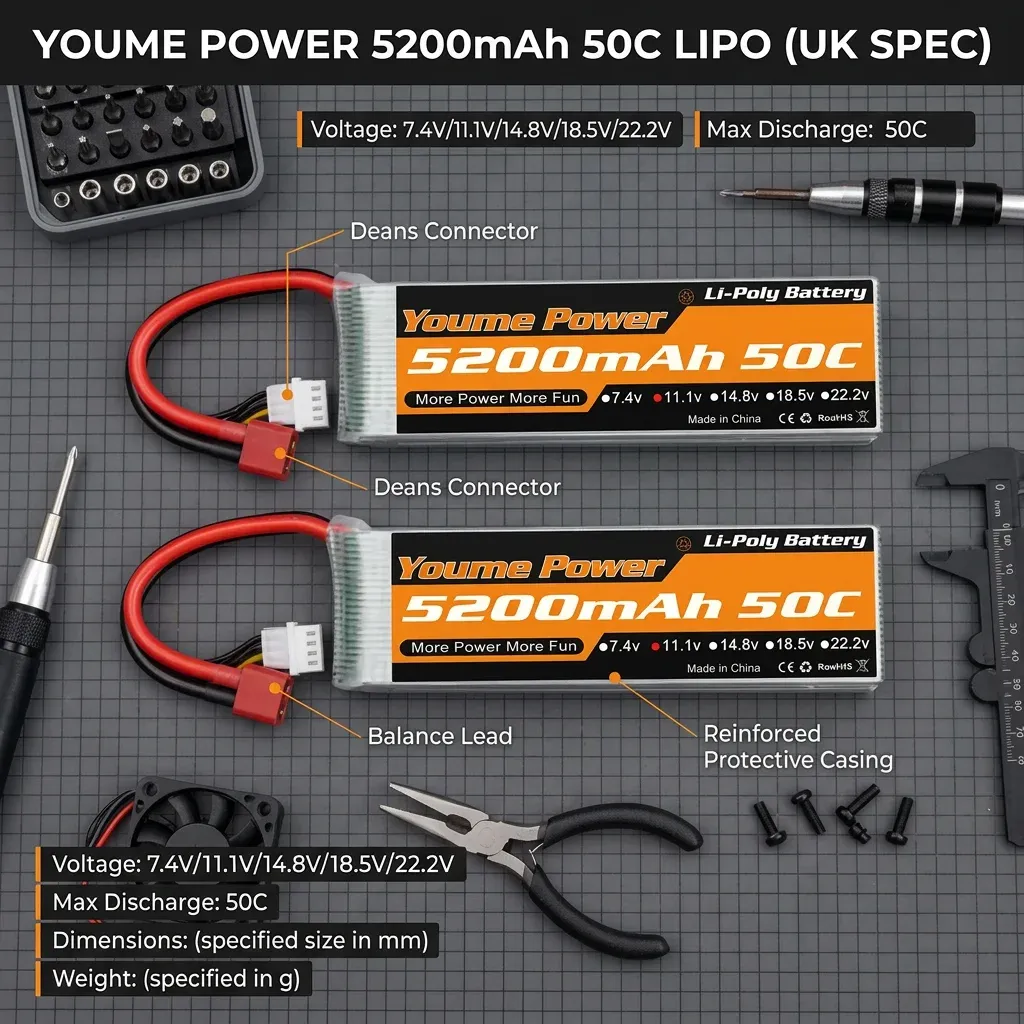
An RC car LiPo battery 3S is a three-cell lithium-polymer battery with a nominal voltage of 11.1V, designed to deliver high-performance speed and torque to compatible remote-control vehicles. Consequently, upgrading to this setup is the single most effective modification you can make for immediate speed gains. If you are currently running a 2S setup or standard NiMH packs, making the jump to a 3S lithium-polymer battery transforms a moderately paced basher into a high-performance machine capable of standing backflips and blistering straight-line speeds.
However, managing that immense power requires an understanding of voltage, discharge rates, and proper battery care. Based on our extensive testing at LiPo Packs UK—running RC trucks and buggies across damp British parks and competitive astroturf tracks—we have seen firsthand how the right 3S pack dictates the entire driving experience. Therefore, this guide breaks down everything UK hobbyists need to know about 3S LiPo batteries, from decoding the technical specifications to adhering to UK safety guidelines.
Key Takeaways
- Massive Power Increase: A 3S LiPo delivers 11.1V nominal power, offering a 50% voltage increase over standard 2S packs, resulting in significantly higher motor RPM.
- Discharge Matters: A 50C rating ensures your battery can deliver the rapid bursts of current required for hard acceleration without overheating.
- UK-Specific Care: British winter temperatures temporarily increase internal resistance in LiPos; keeping packs warm before running is crucial for maximum punch.
- Form Factor: Compact, short-form-factor 3S batteries offer better weight distribution and fit a wider variety of 1/10 and 1/8 scale RC chassis.
What is a 3S LiPo battery for an RC car?
To fully grasp the capability of a 3S pack, we must first look at its internal chemistry and construction. LiPo (Lithium Polymer) batteries are constructed using individual cells. Each standard LiPo cell has a nominal voltage of 3.7 volts. The "3S" designation simply means there are three of these cells wired together in series.
As a result of wiring them in series, the voltages combine: 3.7V + 3.7V + 3.7V equals a nominal voltage of 11.1V. When fully charged, a healthy 3S pack will actually read 12.6V (4.2V per cell). Conversely, when depleted to its safe cutoff point, it should read no lower than 9.6V (3.2V per cell).
Furthermore, this 11.1V output is the sweet spot for many intermediate to advanced RC vehicles. It provides enough voltage to spin brushless motors at incredibly high RPMs, delivering the aggressive top speeds and fierce torque required for competitive track racing or heavy off-road bashing.
What does 5200mAh and 50C mean on a 3S LiPo?
While voltage dictates the speed, capacity and discharge rates dictate how long and how aggressively you can drive. When selecting an RC car LiPo battery 3S, you will typically see two other major numbers: the mAh (milliampere-hour) and the C-rating.
The 5200mAh Sweet Spot
Capacity effectively acts as the size of the battery’s "fuel tank." For instance, a 5200mAh battery can output 5.2 amps for one hour continuously. In the context of an RC car running a 3S setup, a 5200mAh capacity perfectly balances runtime and weight. Larger capacities (like 7000mAh) add significant physical bulk and weight, which can negatively alter the centre of gravity of your vehicle, making it sluggish in corners. In our workshop tests, a 5200mAh pack typically provides between 15 to 30 minutes of runtime, depending on your throttle finger, motor efficiency, and the terrain.
Understanding the 50C Punch
The C-rating (or discharge rate) is arguably just as critical as the voltage. It measures exactly how quickly the battery can safely release its stored energy. To calculate the maximum continuous amp draw, you simply multiply the capacity by the C-rating. Thus, for a 5200mAh (5.2A) battery with a 50C rating, the math is 5.2 x 50 = 260 Amps of continuous discharge capability.
Ultimately, this high discharge rate is what gives an RC car its "punch"—the ability to instantly accelerate out of a corner or launch off a ramp. Lower C-rated batteries will suffer from voltage sag under heavy load, causing the car to feel sluggish. For a deeper dive into why high discharge rates are vital for modern brushless setups, read our comprehensive Ultimate Guide to 50C RC LiPo Batteries in the UK.
Which 3S LiPo battery fits my RC car?
Even the most powerful RC car LiPo battery 3S is utterly useless if it does not fit your chassis or connect to your Electronic Speed Controller (ESC). Ensuring compatibility is paramount.
The Short Form Factor Advantage
Historically, 3S batteries were notoriously long and bulky, forcing hobbyists to heavily modify their battery trays. Fortunately, modern engineering has allowed for "shorty" or compact form factors. A compact 3S 5200mAh pack fits seamlessly into standard 1/10 scale buggies, short course trucks, and 1/8 scale bashers without requiring custom foam spacers or chassis modifications. Consequently, this centralises the vehicle's mass, improving mid-air control during jumps and significantly reducing chassis roll during high-speed cornering on high-grip UK astroturf tracks.
The Reliability of the Deans T Plug
The connector serves as the vital gateway between your battery and your motor. Because high-voltage 3S setups require connectors capable of handling high electrical currents without melting or causing resistance bottlenecks, choosing the right plug is critical. The Deans T plug remains one of the most reliable, standard-issue connectors in the UK RC scene. Its gold-plated spring terminals ensure a high-surface-area connection, reducing electrical resistance to near zero. If you are unsure about connector types or want to understand why this plug is an industry standard, explore our dedicated resource on the Deans T plug LiPo battery.
How do you safely charge and store a 3S LiPo battery in the UK?
Lithium-polymer chemistry is incredibly energy-dense. According to industry data, modern high-discharge RC LiPo batteries boast an energy density of roughly 150–250 Wh/kg. While this density provides thrilling performance, it unequivocally requires disciplined safety practices, especially in the UK where weather and specific storage regulations play a major role.
Managing British Weather
The UK’s damp, cold winters present a unique challenge for LiPo batteries. Specifically, cold temperatures cause the internal resistance (IR) of LiPo cells to spike. If you take a freezing cold 3S pack out to the park, you will experience severe voltage sag—the car will feel slow, and the low-voltage cutoff (LVC) on your ESC may trigger prematurely. Therefore, always store and transport your batteries at room temperature. We recommend keeping them securely in a LiPo safe bag inside your vehicle until you are ready to run.
Charging and Storage Protocols
According to UK guidelines for hobbyist electronics, you must never charge a 3S LiPo unattended. You must always use a dedicated balance charger configured specifically for 3S (11.1V) LiPo chemistry. The balance lead (typically a 4-pin JST-XH connector on a 3S pack) ensures that all three cells charge equally to 4.2V. If cells become unbalanced, the battery can become dangerously unstable.
Furthermore, if you are grounded by a week of rainy British weather, do not leave your 3S battery fully charged. Crucially, you should use your charger's 'storage' mode to bring the pack down to 3.8V per cell. Storing LiPos at this optimal voltage prevents cell degradation and swelling, ensuring your battery is safe and ready for action when the sun finally comes out.
Ready to upgrade your rig with LiPo Packs UK?
Shop Now — £63.99